
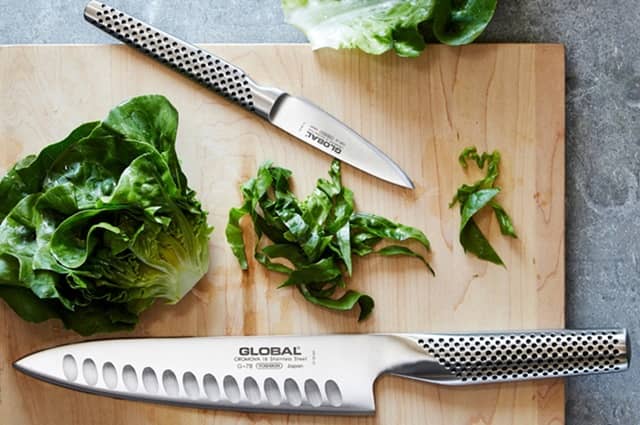
If there’s a foundation for any well-equipped kitchen, it starts with two knives: the chef’s knife and the paring knife. The chef’s knife is the all-purpose workhorse, built to handle everything from slicing vegetables to breaking down proteins. Its larger size and curved blade make it the go-to for most prep tasks. The paring knife, by contrast, is small and nimble for peeling fruit or any task that requires control in tight spaces. Together, these two tools cover nearly every cutting need in a home kitchen.
Size, Shape, and Design Differences
At a glance, the differences are obvious, but they matter more than you might think. A chef’s knife has a broad, tapered blade with a slight curve, allowing for a rocking motion that speeds up chopping and mincing. That extra length also provides leverage, making it easier to cut through dense foods like squash or large cuts of meat. The Victorinox Fibrox Pro Chef’s Knife is a prime example. It features an 8-inch stainless steel blade and an ergonomic handle made from thermoplastic Elastomer for a non-slip grip even when wet.
A paring knife, on the other hand, has a short, narrow blade with a pointed tip. It’s designed to be held almost like a pen, giving you finer control for delicate work. Where the chef’s knife thrives on a cutting board, the paring knife often works best in-hand.
What Each Knife Does Best
The simplest way to think about it: the chef’s knife handles volume, while the paring knife handles detail.
A chef’s knife excels at chopping onions, slicing meat, mincing herbs, and tackling large batches of ingredients. Its versatility is exactly why it’s considered the most essential knife in any kitchen, and it can handle nearly any task you throw at it.
The paring knife steps in when precision matters. Peeling apples, deveining shrimp, trimming stems, or making decorative cuts are all jobs where a larger blade would feel clumsy. It’s less about strength and more about control.
Precision vs. Power
The chef’s knife brings efficiency and momentum, letting you move quickly through prep work. The paring knife slows things down, offering accuracy where a heavy blade would be overkill.
Ever tried peeling a potato with a chef’s knife? It’s awkward. Try chopping a pile of carrots with a paring knife? That’s inefficient. Each tool is designed with a specific rhythm in mind, and cooking becomes noticeably smoother when you use them that way.
Do You Really Need Both?
Technically, you can get by with just a chef’s knife. It’s versatile enough to handle most kitchen tasks, especially if you’re cooking simple meals or working with larger ingredients.
But that versatility has limits. Once you start doing more detailed prep or anything that involves peeling, trimming, or working with smaller ingredients, a paring knife quickly proves its value. It fills the gaps a larger blade simply can’t handle comfortably.
For most home cooks, the answer is straightforward: the chef’s knife is the foundation, but the paring knife is what makes your prep more precise, efficient, and enjoyable.