
Every tailgate has one person who skips the bourbon and brings Scotch. They’re onto something. A good single malt whiskey holds up next to a rack of ribs, as long as you match it to the food and don’t pour it warm at 2 p.m. on a hot asphalt lot. Here’s how to do both.
What makes it a single malt?
A single malt whiskey is made from 100% malted barley at one distillery. It has to spend time in wooden casks, and it goes into the bottle at 40% ABV or higher.
Scotch is fussier. It must come off copper pot stills and sit at least three years in oak casks no bigger than 700 liters. American single malt has no minimum age at all unless the label says “straight.”
If you want every country’s version side by side, The Whisky Club’s guide to single malt whiskey covers it. They’re Australian, so they spell it whisky, like the Scots do. (Both spellings go back to the Gaelic uisge beatha, “water of life.” I stick with the American one here.) The part I use most is their color tip. A golden whiskey usually aged in bourbon casks and tastes of vanilla and fresh fruit. A reddish one points to sherry casks, which push it toward dried fruit and chocolate.
One catch: Scotch makers are allowed to add caramel coloring. If the label says “natural color” or names the cask, trust that over your eyes.
“Single” refers to the distillery. Most bottles still mix dozens of barrels from that one site. Only a bottle labeled “single cask” comes from just one.
Match the bottle to what’s on the grill
For food, cask and peat tell you more than the age statement does.
Burgers and grilled chicken
Hand the friend who swears they hate Scotch a glass from this group. Most Speyside and Highland malts age in ex-bourbon barrels, so they taste of vanilla and ripe pear. That’s light enough that a cheeseburger or lemon-pepper chicken thighs still taste like themselves. Glenmorangie Original is the easy grab at most US liquor stores. I like Old Pulteney 12 a bit more. It has a faint salty edge that works with anything charred.
Brisket
Dark, peppery bark can take something richer. Macallan 12 Sherry Oak and Glendronach 12 both carry raisin and cocoa notes that sit right next to the beef fat. You’ll pay for it. Sherry casks cost distilleries a lot, so fully sherried bottles usually cost more than bourbon cask bottles of the same age. Glendronach is the cheaper of the two, and with brisket I don’t think you lose anything.
Ribs and pulled pork
Nobody is neutral about peat. Barley dried over a peat fire gives whiskey smoke, and sometimes a medicinal note people compare to bandages. Islay is famous for it. Laphroaig 10 and Ardbeg 10 match the smoke ring on hickory ribs, though half the tailgate will make a face at either one, so bring an unpeated bottle too.
If I could pack only one, it would be Talisker 10 from the Isle of Skye. The smoke is gentler, and the peppery finish suits a vinegar-based pulled pork sauce.
Spicy wings
Hot sauce and high-proof whiskey make each other hotter. Go soft. Bushmills 10 is a triple-distilled Irish single malt, light enough to sip over a couple of ice cubes between wings.
How to serve single malt whiskey at a tailgate
Heat makes whiskey smell boozier. A warm bottle gives off more alcohol on the nose, so a pour that’s lovely in your living room can smell sharp in the sun. Keep bottles in a shaded cooler bag until you pour. They don’t need ice.
Neat
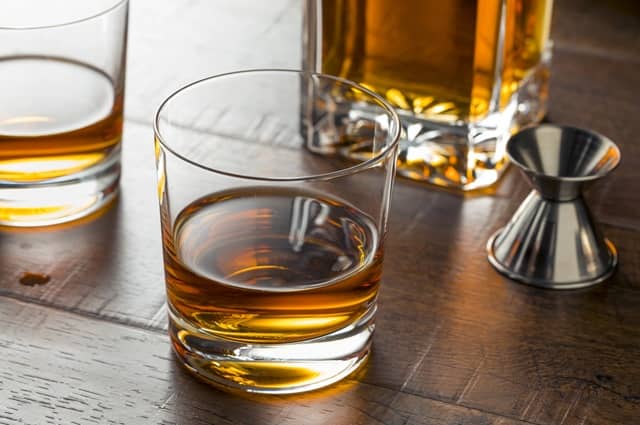
An ounce and a half in a Glencairn or any tulip-shaped glass is the standard pour. A sturdy rocks glass works too. Try to skip the red Solo cup, since the plastic smell gets in the way. Neat shows you most clearly what the cask did, so this is where your favorite bottle belongs.
With a splash of water
A few drops of room-temperature water open up the aroma. For cask strength bottles, some of which top 55% ABV, it’s close to required. Add it slowly from a bottle cap or a straw and taste between drops. Too much flattens the whiskey, and there’s no taking it back out.
Over ice
Ice mutes the flavor. On a 90-degree afternoon, plenty of people take that deal. Use one big cube or sphere so it melts slowly. The lighter bourbon cask malts handle the cold best, because their fruit still comes through. I’d keep the sherried and peated bottles neat. You paid for those flavors.
In a simple highball
Japanese bars made the whiskey highball a staple, and it’s my pick for a long afternoon outside. It stays cold and goes with almost anything off the grill.
- Fill a tall glass to the top with ice.
- Pour in 1.5 ounces of a bourbon cask single malt.
- Top with 4 ounces of cold soda water, pouring down the side to keep the bubbles.
- Stir once gently and twist a strip of lemon peel over the top. Swap in a peated malt for a smoky version to drink with ribs.
Your tailgate whiskey kit
Wrap the glasses in a towel inside the cooler bag so they don’t knock together. Bring big ice in its own bag, away from the beer cooler, which is usually half meltwater by halftime. Keep a small bottle of water out of the cooler for splashing, since cold water dulls the aroma. And pack a jigger. Once people start pouring for each other, an ounce and a half pour has a way of turning into a three ounce pour.